The dashboard
See where each team is struggling.
And what you do about it.
Per team, per depot and for the whole company, you see how your drivers are doing. If something drops, a card is ready with what you can do. Who answered what, you never see.

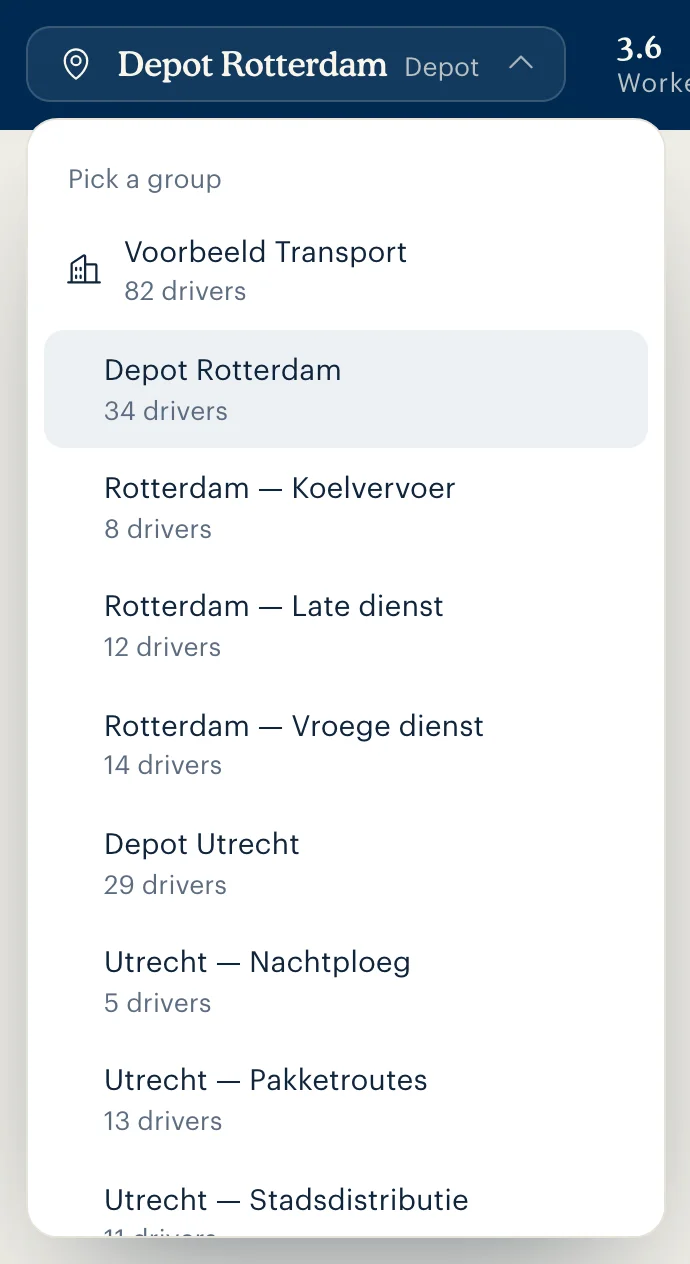
- Choose at the top what you look at: the whole company, a depot or one team.
- You see the WorkerJoy score, and the response as a range or a word, never as an exact figure.
- The open points of attention are at the top, with a button to Take action.
First pilot partner
-
 Electric forklifts · drivers almost always on the road
What you do about it
A card for every point of attention.
And someone who takes it on.
If a topic drops below the threshold in a team, or falls several measurements in a row, a card is ready on Take action: what the figures show, one step to take, one thing better not to do and three questions for the team conversation. Written from that team's figures, not a fixed text per topic.

- Whoever picks it up puts their name on it. So your colleagues see what is open, what is being worked on and what is done.
- For a depot or the whole company too, when a pattern only shows in the sum.
- The same rule on every card: Ask about the work, never about who answered what. Nobody can see that in the dashboard, and whoever asks anyway will not get an honest answer next time.
Who looks at it? When you open the dashboard, the open points are at the top of Overview. If something is waiting for you, you get an email at 9 in the morning on a working day: for a new point of attention, for a point nobody has taken on for two weeks (if you may take it on), for a new report from a driver (if you may see Driver reports) and when the quarterly measurement is ready. The email says what is waiting and where, never what is in it, and you switch each kind off separately under My account. A card stays until somebody completes it, with the name of whoever picked it up. And during the pilot we call you every two weeks: what stands out, what needs to change.
Compare
Put your teams and depots side by side.
And see where the difference is.
An average across the whole company says little; the difference between two crews says everything. Put them side by side on every topic, and choose at the top what you look at: the whole company, one depot or one team.

Who looks with you
For each person you choose a role and what they see: management and HR the whole company, a depot manager their own depot, a team leader only their own team, on the phone too. Letting someone else look costs nothing extra.
What you see with your team sizes
A team gets scores once a measurement closes in which 5 drivers answered, in a team of at least 7. If fewer answer, that cell stays empty and their answers count in the depot and the company, once there are enough answers there together. If a crew drops below 7 working drivers, its scores count nowhere and the dashboard says so; merge it with another one.
What you measure
One WorkerJoy score, 10 topics beneath it
The WorkerJoy score says whether something is going on, the topics say what. Each week the questionnaire covers five of the ten; once a month a slightly longer questionnaire asks all topics at once, instead of the short one. In March, June, September and December that longer questionnaire looks back on the whole quarter.
-
Workload
How often did you have enough time to drive without rushing this week?
-
Physical safety
Were you able to load and unload safely this week?
-
Psychological safety
Do you dare to speak up when something is bothering you, without fear of consequences?
-
Leadership
Could you go to your manager with questions or problems?
-
Social support
Could you count on your colleagues when things were busy or difficult?
-
Meaning
Did you see the purpose in what you did this week?
-
Work-life balance
Did you manage to switch off from work after your shift?
-
Future confidence
Do you see yourself still working here in the time ahead?
-
Autonomy
Could you set your own work pace when needed?
-
Recognition
Did someone notice your effort or give you a compliment this week?
The WorkerJoy score comes from the answers to the questionnaire, not from conversations. Joy is our AI agent for your drivers, on the same WhatsApp number as the questionnaire. What your drivers discuss with Joy, you do not see, unless a driver asks for something to be passed on. More about Joy
Where these topics come from is on the research page.
Beside the figures
What drivers choose and write
Figures show where things pinch. Drivers sometimes say themselves what it is about. You see that on two screens.
Open answers
What is going on per team
- Rotterdam — Late dienst Planning and trips most often ‘not good’
- Utrecht — Pakketroutes Appreciation most often ‘good’
In every questionnaire drivers choose from a fixed list what their week was mostly about and how it went, or ‘nothing special’. Only once at least 3 drivers in one team chose the same thing in the same week, in a week in which at least 5 of them answered, can it appear with that team, and then it stays for twelve weeks. WorkerJoy looks once every two weeks, a team has at most two at a time, from different weeks, and you never see how many drivers chose something, or in which week.
Three things are seen only by somebody with the whole company in view: Manager, Colleagues, and Contact with the office and planners. On the screens and in the monthly report of a team leader or depot manager who has only their own team or depot in view, they never appear: they may be about that person, or about somebody they work with every day.
What drivers type
- “way 2 little time between runs man… n planning never calls back or smth”
- “za malo czasu miedzy kursami a planista nigdy nie oddzwania”
- “prea putin timp intre curse si planificatorul nu suna niciodata inapoi”
- … and more
WorkerJoy summarises it in neutral language
What you see
Planning leaves too little room between runs and feedback does not come back.
You see a theme only once 10 drivers in one team have written about the same thing in the same measurement. In a team of fewer than 10 drivers that cannot happen, and in larger teams it is not common either; what drivers chose can appear there.
What someone wrote word for word, you never see.
-
Work-life balance
Late changes to the roster make it hard to plan anything at home.
-
Physical safety
Small defects on the vehicles stay unrepaired for too long.
Driver reports
If a driver wants you to know something, such as an unloading spot without light, Joy first asks whether she may pass it on. Only after a YES do you see it the next day under Driver reports: what is wrong and where, in Dutch, without a name, team or time.
A report is attached to no team or depot, because then it would say something about the people there. That is why only an administrator or HR analyst sees Driver reports.

Pass it on
One month in one report.
Ready for your management meeting.
Every month the Monthly report is ready in your dashboard: the ten topics beside the start and the previous month, your depots or teams side by side, and how many cards on Take action are open, in progress or done. You print it or save it as a PDF, for your management or a colleague who may see what you see; a team leader prints their own report. There is no figure in it that is not in the dashboard too.
And further in your dashboard
- Trends: every topic over the weeks, per team or depot.
- Quarterly measurement: what the quarter's long questionnaire showed, as a report.
- Drivers: your list of drivers, per team.
- Signing up: the poster your drivers sign up with, and per team whether there are enough of them.
- Measurements: every questionnaire that went out, when it closes and to which teams. The response is on Overview and Trends.
- Materials: explanations to share, such as an A4 on what not to do, for your team leaders.
The line
Why your drivers answer honestly
Anyone who thinks an answer can be traced back fills in ‘all fine’. That is why the line is built into the product: the thresholds are the same for every company and are not in a settings screen, so nobody can lower them for your company, not even you. This is not a monitoring system.

Never visible
- Who gave which answer.
- What someone wrote, word for word.
- Conversations with Joy. A report only comes after the driver says YES.
- Scores of a group with fewer than 5 answers, or of a team smaller than 7.
- How many drivers chose or wrote something, or in which week.
- An exact response rate, or who did and did not answer.
- Where a driver drives or is (no GPS), trips, driving behaviour or performance figures.
What your team leaders take with them. Every card carries the same rule, and under Materials there is an A4 on what not to do, to hand out.
Want to put this beside the GDPR? Read the privacy page and request the documents from us.
Become one of the first pilot partners
See your own teams in this dashboard
In the pilot we create your account and you put your drivers and teams into it. After every week you see the scores of the teams in which 5 drivers answered. In week 10 you decide whether to carry on. On working days we reply within 2 hours (9:00–18:00).
The pilot is free.